She had been trying to have a baby for more than twelve years.
In that time she’d done one IVF cycle in the UK. It produced four embryos, which sounded like a good start. The first transfer was negative. So was the second. A third was planned, but the last embryo didn’t survive thawing. After that came years of questions, and the quiet fear many patients will recognise: maybe nothing will ever work for me.
At 38, with endometriosis confirmed by laparoscopy, an AMH of 0.94 ng/ml and a history of failed implantation, she decided to try again. This time she came to Dr Serap Kağan,
The doctor behind the case
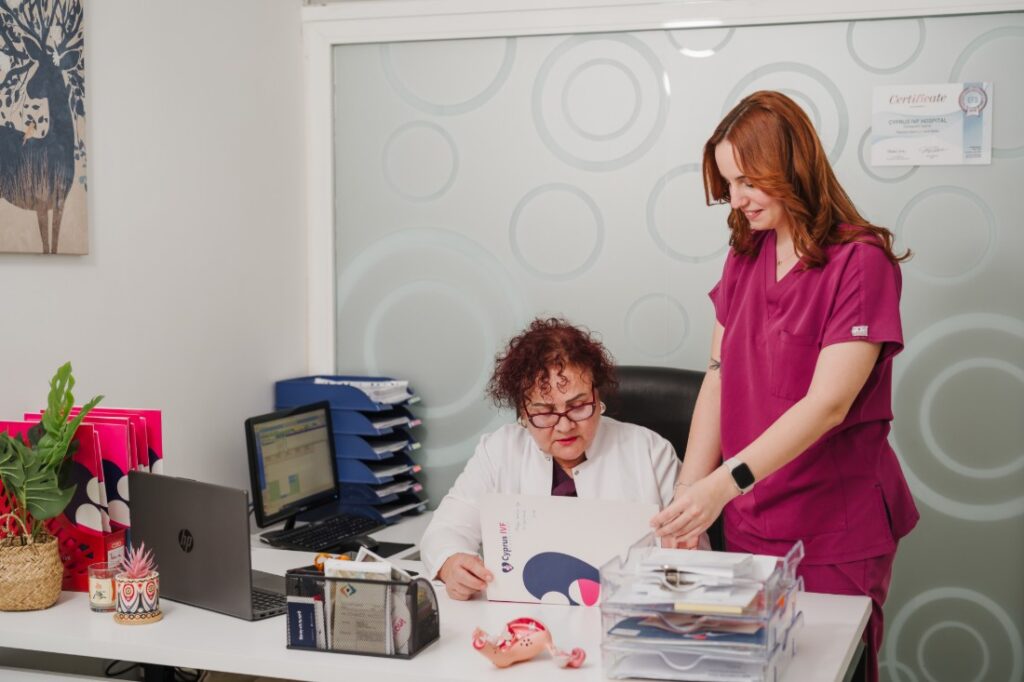
Dr Serap Kağan is an IVF specialist and obstetrician-gynaecologist with more than 36 years of experience in medicine. She studied at Ankara University Faculty of Medicine and specialised at Zekai Tahir Burak Women’s Hospital and Maternity Home. She completed her IVF specialisation at Memorial Hospital IVF Center in 2008, and has worked in IVF ever since.
Her main interests are exactly the situations that leave many patients feeling stuck: advanced maternal age, ovarian stimulation protocols and implantation failure. She also treats endometriosis, diminished ovarian reserve, PCOS and other ovulation disorders, fibroids and other uterine factors, tubal factors and unexplained infertility.
Would you like Dr Serap Kağan to look at your case? Send your medical history to Cyprus IVF Hospital and ask for a second opinion.
Looking for what had been missed
Two failed transfers of good embryos aren’t always „just bad luck”. So instead of simply repeating the previous plan, Dr Kağan started by asking why the embryos hadn’t implanted.
- Checking the blood and the immune system. The patient had a full thrombophilia workup, which tests for inherited and acquired blood-clotting disorders. The results were normal. Natural killer (NK) cell testing, however, showed elevated NK cell activity. That finding shaped the rest of the treatment.
- A stimulation plan built for her. Ovarian stimulation used a combination of gonadotropins with a GnRH antagonist protocol. After egg collection, all embryos were frozen, so the transfer could take place later in a carefully prepared cycle.
- Preparing the womb with endometriosis in mind. Because of her endometriosis, she started downregulation with Buserelin on day 21 of her cycle. When her period began, the dose was halved and low-dose oestrogen was added. The frozen embryo transfer cycle then followed two phases: preparing the lining of the womb, then luteal phase support.
- Support for the immune response. One day before the transfer, Neupogen (filgrastim) was added to her protocol because of her elevated NK cell activity.
The results before transfer
Twelve eggs were collected. Nine were mature and were fertilised with her partner’s sperm, and six of them developed into blastocysts.
IVF Abroad - Patient's Guide 2026
IVF Costs, Success Rates and Laws in 11 Countries Compared + Country Popularity Report.
IVF Abroad - Patient's Guide 2026
IVF Costs, Success Rates and Laws in 11 Countries Compared + Country Popularity Report.
Lost in clinic options? Talk to our IVF advisor.
We’ll help you find trusted IVF clinics abroad - tailored to your medical needs, budget, and treatment goals.
Looking for "best" IVF clinic abroad?
We analyse your needs, treatment type, destination preferences and find top IVF Clinics for you.
Compare IVF Programs Offered by Top Clinics
From IVF guarantees to medications, IVF laboratory techniques, and additional services (add-ons) - all in one place to help you choose with confidence.
On day 12 of her preparation cycle, the lining of her womb had reached 9.2 mm and luteal phase support began. One day before the transfer, her progesterone level was 23.5 ng/ml.
The detail that made the difference
During the consultation, the patient mentioned something that could easily have been overlooked: her earlier embryo transfers had been technically difficult, and a senior specialist had needed to step in.
Dr Kağan took that seriously. During egg collection she performed a mock embryo transfer, a short trial run that shows the shape of the cervix and uterus. It revealed a C-shaped curve in the cervical canal. Knowing this, she could choose the right transfer catheter in advance, so the real transfer would be as smooth as possible.
Given the patient’s history, a double embryo transfer was recommended. One 4AA blastocyst and one 3BB blastocyst were transferred.
The news she had waited twelve years for
Twelve days after the transfer, her blood test showed a beta-hCG of 186 IU/L and a progesterone level of 27 ng/ml. Forty-eight hours later her hCG had risen to 587 IU/L.
Lost in clinic options? Talk to our IVF advisor.
We’ll help you find trusted IVF clinics abroad - tailored to your medical needs, budget, and treatment goals.
She continued Leucostim (filgrastim) until week 8 of the pregnancy. At the time of writing, she is 24 weeks pregnant.
In Dr Kağan’s words
„This case highlights the importance of an individualised and patient-specific approach in reproductive medicine. Identification of the patient’s endometriosis and elevated NK cell activity allowed us to tailor the treatment protocol accordingly and optimise endometrial receptivity. In addition, careful evaluation of the cervical and uterine anatomy enabled the selection of the most appropriate transfer catheter, which played a significant role in facilitating a smooth embryo transfer procedure and ultimately contributed to the successful outcome.
Overall, this case demonstrates how detailed assessment and personalised protocol planning can have a substantial impact on treatment success in complex infertility cases.”
If this sounds like your story
Every patient is different, and no doctor can promise the same result for you. But if you’ve had failed transfers, live with endometriosis, or feel that something in your earlier treatment was never fully explained, a fresh pair of eyes can help.
Sometimes it’s a test that was never done. Sometimes it’s a detail you mentioned in passing, like a difficult transfer, that nobody followed up.
Would you like Dr Serap Kağan to look at your case? Send your medical history to Cyprus IVF Hospital and ask for a second opinion.