
Are you seeking IVF in Spain?
Most people from abroad come to Spain for egg donation or embryo donation. There are many fertility clinics in Spain and the vast majority are private. They are located throughout Spain and travel is very easy as many budget airlines fly to these destinations.
Success rates are very good for egg donation and many people are usually very happy with the treatment they receive at Spanish clinics. The most popular cities where many well-established IVF clinics are located in Spain are: Barcelona, Madrid, Alicante and Valencia.

Free IVF Spain Guide (PDF)
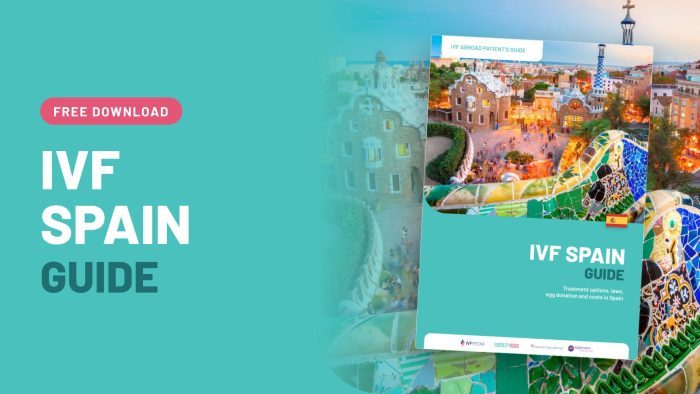
The IVF Spain Guide is a free 12-page PDF on who can have IVF in Spain, the donor rules and what treatment really costs. A basic IVF package with your own eggs costs €3,600 – €6,700 in Spain, and IVF with donor eggs €6,500 – €8,500. Download it, save it, share it. No email needed.
What’s inside:
- Who can be treated: age limits, single women, female couples and ROPA
- Egg donation rules: donor age, anonymity, donor backgrounds
- Sperm and embryo donation rules
- Basic package prices for IVF, donor eggs, embryo donation, egg freezing and ROPA
- Extra costs: consultations, PGT-A, embryo freezing, frozen embryo transfer
| Topic | Spain |
|---|---|
| Maximum age (women) | 50, some clinics up to 54 |
| Single women | Yes |
| Female couples | Yes, ROPA available |
| Egg donors | Strictly anonymous, aged 18-35 |
| Children per donor | Up to 6 |
| Embryos transferred | Up to 3 |
| IVF with own eggs | €3,600 – €6,700 |
| IVF with donor eggs | €6,500 – €8,500 |
| Embryo donation | €3,000 – €5,000 |
| Egg freezing | €3,500 – €4,700 |
| ROPA | €5,000 – €7,000 |
| Frozen embryo transfer | €1,400 – €2,500 |
| PGT-A embryo testing | €1,800 – €3,200 |
Prices are basic packages. Medication, qualification tests, frozen embryo transfer and embryo freezing cost extra. Prices checked: November 2026.
Is the IVF Spain Guide really free?
Yes. It’s a free PDF you can download straight from this page. There’s no form, no email and no sign-up.
Can I find out who my egg donor is in Spain?
No. Egg donation in Spain is strictly anonymous. You get no identifying details, and neither does your child. The only exception is a serious genetic illness, where a geneticist can ask for the donor’s identity.
Egg Donation Spain
The majority of people from the UK seek egg donation in Spain rather than any other IVF treatment. The egg donation clinics in Spain are set up to accept international patients for this type of treatment. There is clinic staff in place to help with queries and to coordinate treatment. Bigger IVF clinics will have an International department to oversee this aspect. Many staff members will be fluent in English so language is rarely an issue in Spain.
Since egg donation in Spain is anonymous, there are many egg donors and virtually no waiting lists. The donors are screened physically and psychologically. The majority of people who come forward to donate are rejected because of these high standards. Some clinics have frozen donor eggs which means that the synchronisation for egg donation treatment is easier. You can find out more about egg donor welfare abroad here.
The clinics will match you up with an egg or sperm donor. Very little information is available about the donor except for some details of physical characteristics. Sometimes, a match may take longer if there are specific characteristics to fulfill.
You may also like to read – Sperm donation abroad – what you need to know.
Featured Clinics in Spain
Embryo Donation Spain
Many people also come to Spain for embryo donation or ’embryo adoption’. What is embryo donation? This treatment involves using embryos from patients who have completed their family and wish to donate their surplus embryos to others. This, of course, is altruistic and anonymous. Success rates are generally lower than for egg donation because these embryos come from eggs from women of all ages – not just under 35 years. Therefore, the possibility exists that the egg may be from an older woman with a greater chance of having a genetic fault. However, many women feel that this type of ‘adoption’ is more attractive than double donation of donor eggs and donor sperm.
Embryo donation does not usually leave open the option of having a genetic sibling as there are usually fewer embryos available. In addition, there is a possibility of the embryos not thawing well thereby reducing further the number available for transfer.
Most clinics in Spain offer embryo donation as an IVF treatment, although some do not – preferring to use fresh donor eggs and sperm only which offer higher success rates.
Spanish law allows frozen embryos to be stored for as long as the woman is medically fit to use them, and clinics ask you to renew your consent every two years. Usually, there is a charge for the continual storage of frozen embryos. If the clinic has tried to communicate with the parents of the stored embryos twice with no reply, then the possibility is there for the clinic to donate those embryos without consent.
Egg Donation Costs Spain
Our research has shown that there is quite a variation in the cost of egg donation between fertility clinics in Spain. Initial headline prices may not reveal the full cost of the donor egg treatment. We recommend comparing on a like-for-like basis. We have devised an IVF Cost Calculator which you could use to determine IVF costs at each fertility clinic. It may be quite revealing to see the range of different prices for IVF.
There are certain tests that need to be undertaken before treatment can start and the majority of these tests will be an additional cost. Some particular tests are required depending on your age, for example, a mammogram.
Sperm is usually frozen on the first consultation visit. There will usually be an additional fee for this. Some special techniques may also be used during the treatment, for example, culture to the blastocyst stage. Again this may involve an additional cost. It is confusing to understand what is included and what is not.
Another option that you might consider to try and reduce costs is egg sharing. Not all clinics will offer this. Many will only offer one donor with one recipient. It may work out cheaper but it also may reduce the choice of clinic.
Frozen egg donation is also an option in some clinics. This tends to be slightly cheaper and also makes synchronisation with your cycle very easy and perhaps more convenient as you can book your flights quite confidently.
We would suggest using the IVF Cost Calculator to determine an indication of the potential cost for your treatment.
You may also be interested in IVF costs abroad.
Cost range of IVF treatment in Spain 2026
| Treatment | Euro | GBP | US Dollar |
|---|---|---|---|
| IVF with own eggs program | €3,600 – €6,700 | £3,043-£5,664 | $4,062 – $7,560 |
| IVF with donor eggs program | €6,500 – €8,500 | £5,494 -£7,186 | $7,334 – $9,591 |
| Embryo Monitoring (Embryoscope, Time Lapse, Geri, etc.) | €300 – €600 | £253 – £507 | $338 – $677 |
| Medical consultation (with doctor) | €150 – €250 | £126 – £211 | $169 – $282 |
| Sperm freezing | €150 – €350 | £126 – £295 | $169 – $394 |
Spain has become a sought-after destination for patients from around the globe seeking IVF treatment, not only due to its advanced medical facilities but also for its relatively affordable costs. For individuals or couples considering IVF with their own eggs, the financial aspect is an important part of the planning process. In Spain, the cost for an IVF with own eggs program ranges from €3,600 to €6,700. This price bracket is competitive, especially when compared to other European countries and the United States, making Spain an attractive option for many.
For those requiring an IVF with donor eggs program, Spain offers a range of clinics that specialize in this service, with costs varying between €6,500 and €8,500 for a basic package. This is inclusive of the high standards of care and the expertise of medical professionals in the country. Additional procedures such as advanced embryo monitoring techniques, which include the use of Embryoscope, Time Lapse, and Geri systems, are available at an extra cost of €300 to €600, depending on the clinic and the specific technology used. Initial medical consultations typically range from €150 to €250, and sperm freezing services are offered between €150 and €350, allowing for future planning and flexibility. These costs reflect Spain’s commitment to providing accessible reproductive technologies, making it a top-tier choice for those considering IVF treatments abroad.
IUI in Spain
IUI treatment is a fertility treatment that involves directly inserting healthy sperm into a woman’s uterus. Artificial insemination with a donor, so-called AID, is the same procedure but uses donor sperm. The treatment is performed using a small catheter. In Spain, the IVF laws are one of the most advanced in Europe so all potential scenarios are considered and regulated. Therefore, IUI and AID are completely legal and regulated. In general, the cost of IUI in Spanish clinics is substantially less than the cost of IVF or egg donation. It can range from EUR 900 for IUI to EUR 1,400 for AID. Intrauterine insemination (IUI) is recommended in cases where couples have been unsuccessfully trying to conceive for at least 12 months and other causes of infertility have been already ruled out.
Egg Freezing
in Czech Republic and in Spain
Check how much you can save!
CALCULATE EGG FREEZING COSTS IN EUROPE.
IVF Success Rates in Spain
Spain reports its national IVF results to the register run by the Spanish Fertility Society (SEF), and the figures are pooled into the European IVF Monitoring reports published by ESHRE. Spain carries out more egg donation cycles than any other European country, and its pregnancy rates per embryo transfer with donor eggs are among the highest in Europe. With your own eggs the rates fall with age, so ask each clinic for its pregnancy and live birth rate per embryo transfer for patients your age, and whether it reports to the SEF register.
Egg Donation Success Rates in Spain
Egg donation results are reported to the Spanish Fertility Society (SEF), the national scientific society that runs Spain’s IVF activity register.
As well as the overall success rate for egg donation per embryo transfer procedure, the success rate per embryo transferred is also a good indicator.
The country’s liberal laws on assisted reproduction and the anonymity it guarantees to donors make it an attractive option for many international patients. According to data from the Spanish Fertility Society (Sociedad Española de Fertilidad, SEF), the success rates for egg donation in Spain are among the highest in Europe, with many clinics reporting egg donation success rates of over 50% per cycle, and some even reaching up to 70%.
The high success rates in Spain can be attributed to several factors. Spanish clinics often have access to a large pool of egg donors, which allows for a better match and healthier eggs. The donors are typically young women who undergo a rigorous selection process, ensuring that only those with optimal health and fertility contribute to the donor program. Moreover, Spanish clinics are known for their cutting-edge technology and adherence to strict quality protocols.
The SEF closely monitors assisted reproduction techniques and outcomes, ensuring that clinics maintain high standards. Their reports provide transparency and help clinics to continuously improve their services. The SEF also collaborates with the European Society of Human Reproduction and Embryology (ESHRE) to benchmark Spanish clinics against the best in Europe.
Furthermore, Spain’s commitment to research in reproductive medicine means that Spanish clinics often incorporate the latest advancements into their practice. This includes the use of preimplantation genetic testing (PGT) to improve the selection of embryos and techniques like vitrification for egg freezing, which have significantly improved the success rates of IVF with both fresh and frozen donor eggs.
Patients considering egg donation in Spain can also benefit from the comprehensive legal framework that protects all parties involved. The anonymity of donors, which is guaranteed by Spanish law, contributes to a higher availability of donor eggs, reducing waiting times and increasing the chances of a successful match.
In summary, Spain offers a combination of high success rates, advanced medical practices, and a supportive legal environment, making it a top choice for those seeking egg donation treatments. The country’s fertility clinics, backed by the SEF’s oversight and commitment to quality, continue to provide hope to individuals and couples from around the world. For those researching their options, the SEF’s website and clinic-specific reports are invaluable resources for up-to-date statistics and success rates.
IVF Laws in Spain

Spain has passed many assisted reproductive laws. These laws are then enforced by the regional governments.
- Single women are eligible for treatment.
- IVF age limit in Spain:
Spanish law (Law 14/2006) sets no maximum age for treatment, but the vast majority of clinics will only treat people up to the age of 50 years. - Egg and sperm donation is anonymous.
- Only six children can be born from the same donor.
- A maximum of three embryos is allowed to be transferred.
- PGD techniques are allowed when there is a medical indication. Sex selection is not allowed unless there are medical reasons.
- Surrogacy is not recognised.
For more information visit the European Society of Human Reproduction and Embryology – ESHRE – website page covering legislation in Spain.
Read more: Can anyone have IVF treatment abroad?
Safety and Quality in IVF Clinics Spain
Fertility clinics in Spain are inspected by the regional government. They must adhere to specific regulations in order to practise. Many clinics are focussed on quality control and improvement and have additional awards from outside bodies for these aspects. This is very reassuring. There are a number of different types of accreditation for safety and quality but you will see many clinics have ISO accreditation. You can be reassured that regulation is not light.
If you have a complaint about a fertility clinic in Spain it is recommended that you write an e-mail to the clinic director explaining the issue fully. If the clinic does not respond or you are unhappy with the response it is possible to fill in an official complaint form. These forms are available at the clinic itself (this is mandatory). Patients can also contact the clinic’s regional health authority to inform them about the complaint. SEF will be able to guide you with this.
Travelling for IVF in Spain is a well-trodden path, and clinics have a long history of treating people with different types of infertility. It tends to be considered a safe option due to the experience of the IVF clinics. Many people come home very happy and pleased with the care and treatment they receive from Spanish clinics.
IVF in Spain – Testimonials
I never thought I would find such an affordable IVF treatment in Spain. The wide range of egg donors from different ethnic backgrounds gave us hope and options we never had before. The recognised IVF clinics in Madrid, Barcelona, Alicante, and Valencia are conveniently located, and the doctors’ impressive work experience assured us that we were in good hands. Thanks to the IVF clinic in Barcelona, we are now proud parents.
Mary and Gareth, Manchester, UK
IVF in Spain Question and Answers
How much does IVF cost in Spain?
Spain remains the most popular destination with international patients and with over 180,000 IVF procedures undertaken annually there are a multitude of treatment providers. The cost of IVF with own eggs varies like every country but the broad range for a basic package is between €3,600 and €6,700. These costs are amongst the highest in Europe but they should be weighed against good success rates and the standards of care and treatment offered by established clinics. According to the Spanish Fertility Society (SEF), the most popular age group who have own egg IVF treatment in Spain is between 30 and 39.
How much does it cost to freeze your eggs in Spain?
The ability to safely preserve your fertility through egg freezing is one of the greatest medical advances in assisted reproduction treatments, because it gives women more freedom to choose the best time for them to start a family. Egg freezing has become a popular procedure in Spain and the majority of clinics offer it.
Unlike the UK Spain does not have a 10-year egg freezing limit, so you do not have to worry about your eggs being disposed of if you wanted to use them beyond the 10-year limit. A basic egg freezing package costs €3,500 – €4,700, including one year of storage but not medication.
How much does embryo donation cost in Spain?
This technique consists of creating an embryo by fertilizing the egg artificially, then implanting the embryo in the woman’s uterus. It is commonly used by heterosexual couples and single mothers, when the egg is donated or natural fertilization does not work. It is also used for lesbian couples who want to share motherhood of the child, by one them donating the egg and implanting the embryo in the second woman’s uterus, thus they ‘share motherhood’. The cost of this procedure varies between €3,000 and €5,000.
What is the cost of IVF with donor eggs in Spain?
Egg donation treatment offered in Spain consists of an in-vitro donation of oocytes (eggs) from an anonymous donor. This is a treatment which is most popular with international patients who travel to the country and Spain has a large number of clinics and egg banks to cater for this demand. It is regarded as a safe, reliable fertility treatment with high rates of success. Costs for IVF with donor eggs in Spain can vary substantially between clinics. A basic package costs €6,500 – €8,500, and prices can rise above €10,000 when clinics offer multiple cycles.
How much does donor sperm for IVF cost in Spain?
Just as egg donors, sperm donors in Spain are anonymous and this treatment is offered to single women, lesbian and heterosexual couples. Donor insemination is a fertility treatment that involves using a sperm donor to conceive. Insemination typically refers to intrauterine insemination (IUI) with a donor or an intended parent’s sperm, but donor insemination can also be used with intra-vaginal insemination or as part of an IVF cycle as well. Donor sperm from a clinic’s own bank costs €300 – €750, on top of the treatment price.
Why is IVF more successful in Spain?
Spain has become a popular destination for IVF due to its high success rates and favorable regulations. The country boasts numerous private fertility clinics, making it convenient for individuals seeking egg or embryo donation. With easy travel options available, thanks to budget airlines serving various Spanish cities, patients can easily access these clinics and benefit from their expertise and advanced technologies.