Dr Abraham Zavala on IVF: IVF Off The Clock in London
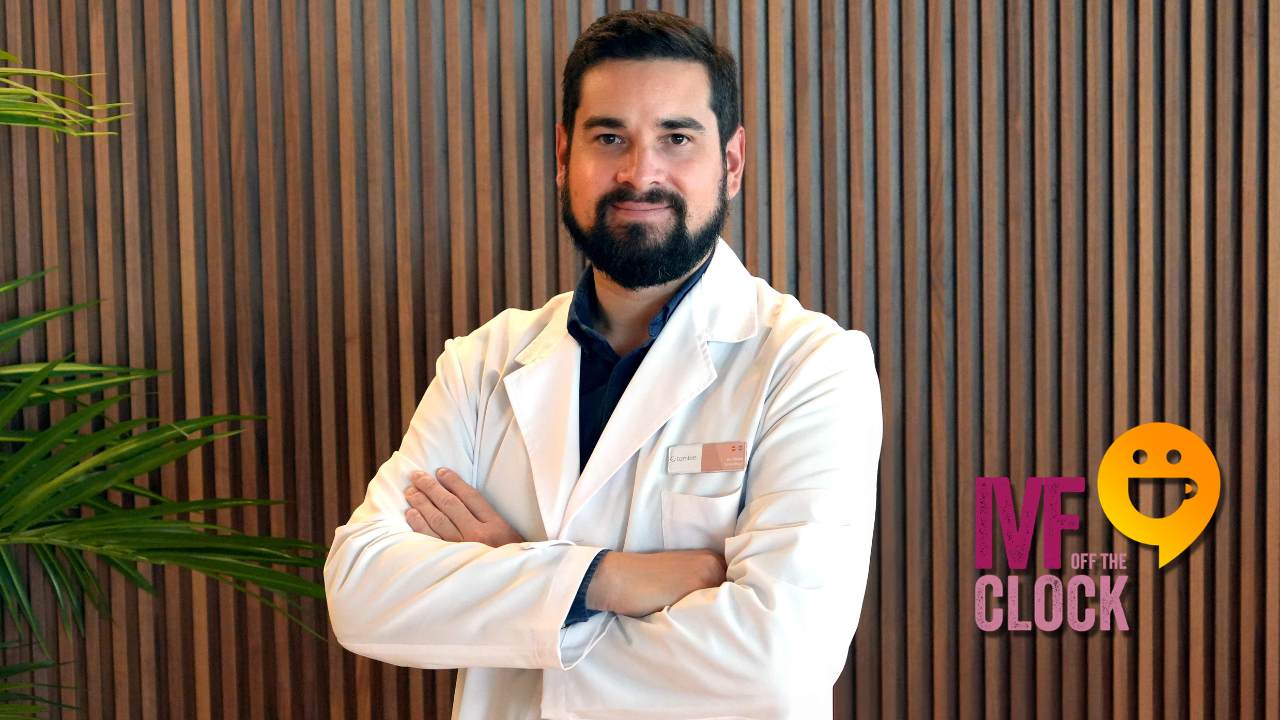
Dr Abraham Zavala, Fertility Specialist & Scientific Director at Clínica Tambre
What is it really like to consider IVF treatment abroad? What do patients from the UK want to know before travelling to Spain for fertility treatment — and how does treatment compare with what they may be used to at home?
As part of IVF Off the Clock, we met Dr Abraham Zavala, Gynaecologist, Fertility Specialist and Scientific Director at Clínica Tambre, during his visit to London. With around 10 years of experience in IVF, Dr Zavala shares his perspective on the questions international patients ask, the practical realities of travelling for treatment, and some of the fertility treatments available at Clínica Tambre in Spain.
Across these episodes, we explore the topics that matter to patients considering IVF in Spain — from IVF with your own eggs and donor eggs to PGT-A, embryo testing, success rates, travel and treatment logistics.
Below, you can watch all episodes of IVF Off the Clock and read the full Q&A with Dr Abraham Zavala.
Whether you are actively considering IVF in Spain or are still researching your options, these conversations offer a chance to hear directly from a fertility specialist about some of the questions patients may want to ask before starting treatment abroad.
Please introduce yourself and tell us a bit more about yourself.
I’m Dr Abraham Zavala. I’m a gynaecologist and fertility specialist, and I work at Clínica Tambre. We have 2 clinics in Spain. We have one in Madrid and another in Alicante.
And how long have you been working in IVF?
I’ve been in this field for about 10 years now.
What do you find still interesting or inspiring about your work?
Well, just every different patient that I see, how they all have their own different story, and how they’re in a different part of their journey. That is something that never ceases to amaze me.
Is that what you find still exciting about what you do?
Even patients who struggle with a similar situation, they might be in two completely different contexts.
We’re here in London today, the capital of England. What do patients from the UK usually ask you before beginning treatment with your clinic?
I see a lot of patients coming from the UK and from Ireland, and one of their recurring questions that we get is: how is treatment different in Spain in comparison to the UK?
Do they also ask about success rates?
That’s one of the more common questions that they might have.
What do you tell them?
Well, we provide them with the success rates that we have for each type of treatment, for both IVF and egg donation.
Is there anything that they are concerned about?
I think a lot of patients understand that, you know, they’re still going to have medication, just as if they were doing treatment elsewhere. But one of their main concerns might be logistics and travel time, and how long they would have to be out in Spain for — those types of questions.
What treatments do patients from the UK typically come to you for?
All sorts of treatments, anything from IUI, IVF, genetic testing, to egg donation and sperm donation.
Let’s talk about IVF with donor eggs for patients from the UK. How is that process typically organised?
So, in Spain, that is an anonymous process, okay? And one of the advantages that we have in Spain, specifically at Clínica Tambre, is that there aren’t any waiting lists, so patients can go straight into their treatment, and that process usually takes about two to three months.
There are two processes happening in parallel: a woman who is preparing her womb lining for the embryo transfer, and the clinic selecting the donor and generating the embryos.
And how many times do they have to come to the clinic and for how long?
Once or twice. We usually like to do an initial consultation in which we can do all the testing and get all the blood tests out of the way.
And then a second visit for the actual embryo transfer.
And do you do fresh and frozen cycles?
We do both, depending on each patient’s individual situation.
What’s the availability of donors like?
So, in Spain, we’re fortunate that, like any other type of donation — blood donation, organ donation — we have a lot of donors in Spain. So fortunately, we have quite a lot of availability, so we have donors to choose from to match the patient’s physical traits.
Let’s talk about IVF with own eggs for patients from the UK. How is that process organised?
So, for that, we have two ways of working. As I said, patients can either come out to Spain and stay there for the entire length of their treatment, which is usually about two weeks.
Other patients may choose to do part of that treatment back home in the UK; in this case, they can go to their own gynaecologist, have a few scans there, and then come to Spain for the egg collection.
And how many times do they need to come to the clinic and for how long?
Anywhere from one to two weeks.
Do you work with fresh or frozen embryo transfers?
So, that’s going to depend on the patient’s response to the medication and on whether or not we’re doing any genetic testing on the embryos.
That’s going to determine whether we can, you know, move forward with a fresh embryo transfer, or whether we need to freeze the embryos, wait for the test results, and then transfer the embryo.
Many of our viewers are from the UK and beyond, and they’re interested in PGT-A. Who needs PGT-A?
PGT-A testing is when we analyse an embryo prior to transferring it to know whether the embryo has, let’s say, the correct number of chromosomes.
Okay, and this is something that we recommend in women over the age of 37, or in women who may be younger than 37 but who may have struggled with issues such as implantation failure or recurrent miscarriages. And one thing that also sets us apart is that we analyse the couple’s or the woman’s karyotype prior to IVF. So, in women in which we find an abnormal karyotype, those are also going to be patients in which we’re going to recommend PGT-A testing.
And how is that process organised?
So once we’ve generated the embryos after the egg collection, and we’ve cultured the embryos for five to six days, before freezing the embryos, the lab will take a few cells from that embryo, and those will be analysed. The process usually takes about two to three weeks, and that’s when we find out the results from the PGT-A analysis.
And would you say that it’s worth it, and why?
Again, this is going to depend on each patient’s individual situation and on whether PGT-A might be right for them or not. But patients who undergo PGT-A will have embryos that they know they’ll be able to transfer and that have a really good implantation potential.
What is the upper age limit of patients that you treat?
This is also one of the more recurrent questions that we get because this is something that can differ from country to country. In Spain, it’s not necessarily a law that states what the upper age limit is, but the scientific consensus is that, based on the woman’s individual health, the age or the upper age limit is around the age of 50. So, each case is individualised.
That’s sort of the limit, but it’s going to vary from patient to patient.
Why do patients from the UK choose Clínica Tambre?
I think there are a few factors that come into play when patients decide to have their treatment performed in Spain. As I said, I think one of the more important reasons, or one of the main reasons, is the experience that our clinic has. With almost 50 years of experience as a clinic focused on fertility, I think that’s one of the most important factors.
But also, the experience that each doctor has, the focus that we have on different aspects of fertility, and the technology that we have in our labs. I think that’s something that definitely sets us apart. Also, the way that we go above and beyond to personalise each treatment to every patient’s individual situation. I think those are the main reasons why patients come to us.
Do you remember a particular story or case of a patient or couple from the UK that really stands out for you?
It was a young couple. They were both in their mid-30s, and they had done a total of four rounds of IVF. They were not very optimistic about their chances. Egg quality wasn’t an issue, and ovarian reserve wasn’t an issue, which are some of the more important factors that sometimes go into determining success rates. But after each round of IVF, this patient was getting a good number of eggs, and they were generating embryos. So, the way in which we approached their case was through embryo testing. Most of the embryos that we tested when we did the first round of IVF were euploid, as we would expect based on this couple’s age.
But we also have a reproductive immunology unit, so we took up their case with our immunologists. They ran tests in which we found certain factors that had not been looked into before treatment. We treated that patient based on those results, and that’s the reason why I’m using this couple’s history as an example, because that went a long way towards helping these 2 people have a child.
So, it’s one of the stories I always remember, and it kind of makes me happy to do that.
For a 39-year-old who didn’t have any normal embryos after PGT-A testing, with four embryos tested, what questions should she be asking her doctor? What should the clinic be looking at or recommending?
Well, first of all, I’m sorry to hear about the results from the PGT-A testing. I can just imagine how stressful and anxious they must feel. This would be one of the areas where we would start to look at what the problem may be, because at the age of 39, based on the number of embryos that they’ve had tested, we would expect an embryo to be euploid by now.
So, one of the things that we would recommend is doing karyotype testing on both the woman and the man, to see if there’s anything abnormal that may be influencing the PGT-A results. We can also consider doing FISH sperm testing.
This patient has a question about immune protocols and recurrent implantation failure, which I know is your speciality. She has had a previous successful pregnancy, but if a patient has a successful IVF pregnancy and live birth using a specific immune protocol, for example, steroids, intralipids, or other immunotreatment, why might the same protocol not work for subsequent embryo transfers after giving birth?
That’s a great question, and we would need a little bit more information, but there are many factors that go into whether a treatment is successful or not. We would start with the embryo quality and the embryo’s genetics, if that’s something that we know, but also the environment.
The endometrial environment can change over a short period of time. That’s why we recommend doing immunology testing close to the time of the transfer, to try and understand what the conditions are at that time, so that we can provide the appropriate treatment for that situation.
Can pregnancy, childbirth, or a caesarean section alter the uterine or immune environment enough to affect future implantation?
First of all, vaginal delivery, miscarriages, and C-sections don’t necessarily have an impact on future fertility. But there are cases in which they may negatively impact the uterine environment, and that’s something that we can analyse before doing any subsequent embryo transfers.
In your experience, when a patient has several failed transfers or an early miscarriage after a previous successful IVF pregnancy, do you usually recommend repeating the same immune protocol, or would you consider additional investigations, such as a hysteroscopy or further immune testing, before the next transfer?
A lot of what is going to determine whether we stick to the same protocol or extend testing by doing a hysteroscopy or repeating any of the immunology tests is going to be the time after the initial treatment. So, if a pregnancy has taken place and maybe we’ve waited until, or we’ve given some time before seeking a new pregnancy and we’re generating new embryos, there can be significant changes to both the egg quality and the endometrial environment.
At that point, we would normally want to investigate what the current situation is before doing any other embryo transfers.
I have one euploid embryo. Are there any tests that should be done to help make sure everything is ready for a frozen embryo transfer? I’m 39 and have endometriosis, with one known endometrioma of the left ovary.
The evidence for the tests that could be performed has to be discussed, and she also needs to be aware of how endometriosis could potentially impact the embryo’s implantation potential. Endometriomas or endometriosis can affect the uterine cavity in a few ways. It can affect the walls of the uterus through something called adenomyosis, and this can also affect the way that the immune system is regulated.
There are tests that can be performed prior to the embryo transfer, but she needs to be aware of what the upside or downside of acting on those test results might be.
This patient says that she gets a couple of good-quality blastocysts per round, but they’re both aneuploid. What should be her next steps?
This is something that is not entirely uncommon. We know that embryo quality and the embryo’s genetic content are two entirely different things, and the quality doesn’t always tell us what the euploidy or aneuploidy is going to be in these embryos.
There are factors that we would need to look at. First of all, the egg quality, to see what the expected euploid rate would be. And also, we would analyse the sperm quality and see if that’s a factor that could be affecting the outcome of these PGT-A tests.