Dr Guillermo Terrado – Interview with a Doctor
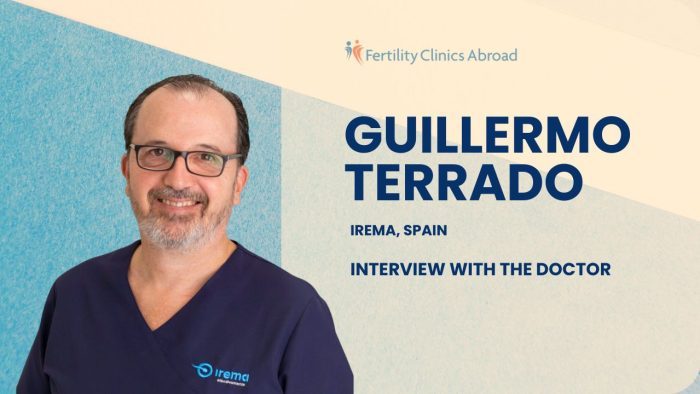
Choosing a fertility doctor is not only about medical experience. For many patients, it is also about feeling listened to, understood, and guided with honesty through one of the most personal journeys of their lives.
In this interview, we speak with Dr Guillermo Terrado, specialist in reproductive medicine at IREMA, who has been working in fertility treatment since 1995. Over more than three decades, he has seen IVF change dramatically — from a highly uncertain procedure available to relatively few patients, to a more advanced, personalised and safer treatment option.
But despite all the progress in embryo culture, vitrification, genetic testing and tailored protocols, Dr Terrado believes one thing remains essential: taking time to listen to each patient and being clear about what medicine can realistically offer.
In this conversation, he shares his perspective on how IVF has evolved, what patients should know before starting treatment, and why honest communication still matters as much as medical technology.
How long have you been working in fertility treatment, and what has changed the most in IVF during that time?
I have been working in Reproductive Medicine since 1995, when I completed my fellowship after my residency in Obstetrics and Gynaecology. That’s more than three decades watching this field transform almost beyond recognition. When I started, IVF was still something of a miracle – a complex, uncertain process that offered hope to a small number of patients. Today, the combination of advances in embryo culture, vitrification, genetic testing and personalised protocols has dramatically improved success rates and, just as importantly, the safety and experience of patients. What hasn’t changed – and what I believe never should – is the need to listen carefully to each person who walks through the door and to be honest about what medicine can and cannot offer.
What brought you to IREMA, and what do you value most about working there?
I joined IREMA in 2020, drawn by its commitment to rigorous, evidence-based medicine and a genuine culture of putting patients first. What I value most is the environment it provides to practise medicine the way I believe it should be practised: with time, with honesty and with a multidisciplinary team that shares the same standards. It is a place where you never feel alone in the more complex cases, and that makes a real difference – both for the clinical outcomes and for the relationship you build with your patients.
What inspired you to specialize in fertility medicine?
My background is in Obstetrics and Gynaecology, but I was always drawn to endocrinology and to the extraordinary complexity of the reproductive process. There is something deeply fascinating about understanding the hormonal interplay that makes conception possible – and something deeply meaningful about applying that knowledge to help people build the families they have always wanted. When I completed my fellowship in Reproductive Medicine, I knew this was where I wanted to focus my career. Thirty years later, that conviction has only grown stronger.
Looking back at your career, what keeps you motivated when working with patients?
Without doubt, it is the people. Every patient who comes to us is carrying a very personal story – often one marked by hope, disappointment and resilience. Being part of the moment when that journey leads to a positive result never becomes routine, no matter how many years pass. What drives me, day after day, is the possibility of making a difference in someone’s life in the most profound way imaginable: helping them become a parent.
Is there a particular moment or achievement in your career that you are especially proud of?
There is one case that I carry with me always. A patient came to me after five consecutive pregnancy losses – five. She had been through enormous pain, and the road ahead was uncertain. Over time, with a carefully tailored approach and a great deal of perseverance on her part, we succeeded. She went on to have two children. What makes this case so special to me is not just the medical outcome – it is the relationship that grew from it. She and her family became friends. To me, that is medicine at its most human.
From a patient’s perspective, what makes IREMA stand out compared to other IVF clinics in Spain?
I think what distinguishes IREMA most is the combination of scientific rigour and genuine human care – and the fact that these two things are never treated as being in tension. Patients are seen as individuals, not as cases. Their history is listened to carefully, the options are explained honestly – including the limitations – and the treatment plan is built around their specific situation. In a field where patients are often overwhelmed by information and uncertainty, being able to trust that your doctor is being completely straight with you is, I believe, one of the most valuable things a clinic can offer.
Do you have a special area of expertise (for example: low ovarian reserve, male factor infertility, repeated IVF failure)? What types of patients do you most often help?
My area of particular interest is reproductive genetics and preimplantation genetic testing. Understanding the genetic dimension of fertility – whether in the context of chromosomal abnormalities, inherited conditions or recurrent implantation failure – allows us to personalise treatment in ways that significantly improve outcomes for the right patients.
In my day-to-day practice, I work frequently with women who have postponed motherhood and are now facing age-related reproductive challenges. This is an increasingly common reality, and it is why I feel so strongly about encouraging women who wish to delay having children to consider fertility preservation at a younger age – when the biological window is still open. Prevention and early planning can make an enormous difference.
Many patients today travel abroad for IVF. What should they look for when choosing a clinic in another country?
First and foremost: transparency. A good clinic should give you honest, realistic information about success rates, protocols and costs – without overpromising. Beyond that, I would look for a team that communicates clearly and promptly, that takes the time to understand your individual history, and that has genuine expertise in your specific situation rather than a one-size-fits-all approach.
Practical support also matters enormously for international patients – clear coordination, continuity of care with your local doctors and the confidence that you will be looked after not just during treatment, but before and after it too.
Online consultations are now very common. How effective are they in helping you understand a patient’s case and plan treatment?
Very effective, when done properly. The majority of what we need to understand a patient’s situation is their medical history, their test results and – crucially – the conversation itself. A thorough, attentive online consultation allows us to review all of this carefully, ask the right questions and outline a realistic treatment plan before the patient has set foot in Valencia or Alicante airports. For international patients in particular, this means that by the time they travel, everything is prepared and their time here is used as efficiently as possible. Technology, when used thoughtfully, genuinely enhances care rather than diminishing it.
How do you approach patients who have experienced multiple IVF failures? How personalized is their treatment plan?
With great care, and with fresh eyes. A history of repeated failure is never simply accepted as an inevitability – it is a starting point for a rigorous investigation. Why did the previous attempts fail? Was the embryo quality optimal? Was the uterine environment properly evaluated? Were the genetic factors considered? In many cases, when we look closely enough, there is something that was missed or could be approached differently.
Every patient who comes to us after multiple failures receives a completely individualised review. The treatment plan is not adapted from a standard template – it is built from scratch, around their specific situation. And throughout the process, I believe in communicating honestly: about what we can try, what the realistic expectations are, and what success might look like for them.
Can you share an example of a particularly challenging case that resulted in a successful pregnancy? What made the difference?
The case that comes to mind most readily is the one I mentioned earlier – a patient who had experienced five pregnancy losses before coming to me. Each loss had been devastating, and the medical picture was complex. What made the difference, I believe, was a combination of things: a thorough genetic and immunological workup that identified factors that had not been fully addressed before, a personalised protocol, and – perhaps just as importantly – the relationship of trust I built with the patient over time. She never felt like a number. She felt heard. And I think that, in some cases, is what allows patients to find the strength to keep going.
Based on your experience, what is one important piece of advice you would give to patients starting their IVF journey today?
Don’t wait longer than necessary – but when you do begin, choose your team carefully and trust them. Fertility treatment is as much an emotional journey as a medical one, and having a doctor who listens, explains and is honest with you will make that journey far more bearable, whatever the outcome. And if you are someone who is not yet ready to have children but knows that one day you will want to: please consider speaking to a specialist about fertility preservation sooner rather than later. Time is the one factor in reproductive medicine that we cannot recover.
What is one important piece of advice you would give to patients travelling from the UK to IREMA for IVF treatment?
How do you adapt your approach to meet the expectations and needs of patients from this country? What is one important piece of advice you would give to patients travelling from Denmark to IREMA for IVF treatment? How do you adapt your approach to meet the expectations and needs of patients from this country?
My advice to any patient travelling from abroad is simple: make the most of every conversation you have with your medical team before you travel. Distance is no longer the barrier it once was – online consultations allow us to review your full history, answer your questions and have a clear treatment plan in place well before you set foot in our country. By the time you arrive, nothing should feel unknown or uncertain.
In terms of adapting my approach: I don’t think patients from different countries need fundamentally different medicine, but they do deserve the same things – clarity, honesty and the feeling that their specific situation has been genuinely understood. What I have noticed, working with patients from the UK, Denmark, Germany, France, Italy, USA, Australia and beyond, is that what people want most, regardless of where they come from, is to feel that they are being treated as an individual, not as a case in a queue. That is something I take seriously with every patient I see.
Dr Guillermo Terrado is a Reproductive Medicine Specialist with 26 years of experience helping patients on their path to parenthood. His expertise includes Obstetrics and Gynecology, Laparoscopic Surgery, Ultrasound, and Medical Science Liaison.
Passionate about research and education, Dr Terrado has published more than 300 scientific papers and regularly speaks at national and international conferences. He is an active member of the Spanish Fertility Society (SEF) and the European Society of Human Reproduction and Embryology (ESHRE).
Dr Terrado believes in personalized, empathetic care, supporting each patient with the knowledge, guidance, and tools they need throughout their fertility journey.